Showing posts with label Canon. Show all posts

Thursday, September 15, 2011

Digital Press Certifications; Konica Minolta, Xerox, Canon - Interesting Developments...

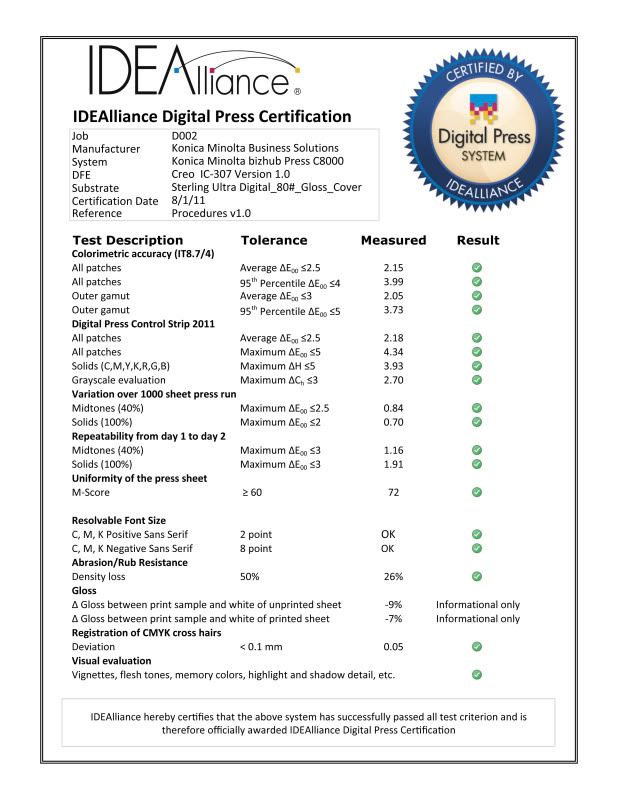
Now here we are a month and a half later and we find that the Konica Minolta is not the only Digital Press that is certified by IDEAlliance. Even thought Konica Minolta was the first to be certified.


The press release was issued August 15th, which was about 2 weeks behind the official date that IDEAlliance issued the actual certification. IDEAlliance issued Konica Minolta's Digital Press Certification on August 1st, 2011.


The Digital Press Certification program is broken into two parts: Part 1 is for Commercial Production (xerographic & ink jet) Devices. Part 2 is for Wide Format and Grand Format Ink Jet Devices. The program consists of testing and certification in areas of color, press sheet properties and print production.

In the certification process, a series of test forms are provided, suppliers print these forms according to a given criteria, the forms are sent to the IDEAlliance designated Evaluation Contractor where they are measured and compared against pre-determined tolerances. Systems that pass all tests are awarded certification, the supplier system details are published on an IDEAlliance web site and the supplier is able to display the certification logo on their product collateral.

This is great news for potential digital press buyers as they will be able to immediately recognize the logo and know that they are considering a product that is already certified. There has been a lot of press surrounding these certifications. The framework for the digital press certification is based on upcoming international standards ISO 12647-8, 15311, and 15339.

Now customers have a way to find their way through an always growing field of Digital Press Products. As of 9/15/2011 The following presses have been certified under the following conditions.

8/1/2011 Konica Minolta Business Solutions got the Bizhub PRESS C8000 with the Creo IC-307/Version 1.0 using the GRACol Print Condition on Sterling Ultra Digital 80# Gloss Cover
 
8/26/2011 EFI got the Canon imagePRESS C7010VP/C6010VP/C6010 with the Fiery A1200/A2200/A3200 using the GRACol Print Condition on EFI Laser Proof XF130 Semi matt 130 gsm
 
9/1/2011 Xerox got the iGen4 Matte Dry Ink Press with the FreeFlow Print Server V8 using the GRACol Print Condition on Xerox Digital Color Elite Silk 140gsm
 
9/6/2011 EFI got the Konica Minolta bizhub PRESS C8000 with the Fiery IC-306/IC-3600 using the GRACol Print Condition on EFI Laser Proof Paper XF130 Semi matt 130gsm
 
Konica Minolta not only has their equipment being certified a quick look at IDEAlliance's website and you will find that 17 Konica Minolta employees are now certified G7 Experts!
 
Konica Minolta has put a tremendous effort in not only producing top of the line affordable digital presses but also in investing in having color experts to help commercial printers and in plant printing operations get their shop certified as a G7 Master Printer using the G7 methodology. Originally when I looked Xerox had like 8 and Kodak had like 7 G7 Experts worldwide. HP did not have 1 certified G7 Expert and neither did Canon, IKON or Ricoh. I have been informed that the first batch of RiKON professionals have now been certified.
 
It is not enough to just make good equipment, but to have the support structure to enable those that purchase the equipment to be successful. The race is on!
 
Pirate Mike
 
For those that would like to keep up with the lastest certifications go to IDEAlliance's Website!

Wednesday, April 14, 2010

Inkjet is building steam; will it ever do anything other than transactional…


Inkjet is building steam and this time in a new report!

"In its "North American Transactional Printing Market Update & Forecast 2009-2014" study, Interquest reports that inkjet presses are gaining volume and installations. Interquest is a leading market and technology research and consulting firm serving the digital printing and publishing industry.

The 2009 study notes that although inkjet equipment accounts for only four percent of the transactional printing systems (monochrome, spot and full color) used by respondents to the survey, inkjet presses produce 35 percent of the total transactional print volume reported – up from 31 percent the year before. The number of print operations using inkjet equipment took a big jump. The survey found that about one-third of the respondents now use inkjet equipment for transactional printing, up from 16 percent in the first half of 2008."

What will be interesting to watch is how well this technology is received as the quality gets better. All I have heard from printers lately have been thoughts that the volumes will not be there if they take the risk and invest in the technology. But transactional and trans promotional volumes are relatively untapped as not many printers have attempted to sell this business. As the economy strengthens companies will have to return to the drawing board and look at their capabilities and ensure that they are investing in areas they can make money in and that has growth potential.

Printers are struggling to reinvent themselves this time as technology is pushing them away from their traditional business. I have had many comments from printers that were a bit on the negative side on the high volume inkjet, I am worried that they will pass this opportunity up and allow the commercial sector to invest which will shut them out of the business completely. In house marketing departments already have the ability to add 3 or 4 small machines to take over much of their companies printing needs. As in-plant facilities grow in capabilities and skill sets traditional printers will lose their foothold.

It is interesting how much cross media advertising that I receive but printers are saying "no one is doing it." Traditional advertising agencies have stayed away from cross media as it requires them to add additional skill sets beyond just the creative. I think it is time to rethink business plans and put away the ideas of "this is how we have always done it." Every day another printer goes out of business or gets acquired by one of the conglomerates. As employment comes back and companies start thinking about capital reinvestment printers need to be the first ones in their ear talking about where they can spend their money.

The print salesman of the last decade will not be the print salesman of the next. Marketing services and solution selling will take over and the idea of asking for "cost center" business will be over with, as most companies can produce that work themselves. If printers keep shying away from the work the commercial sector will use their IT and marketing departments to develop their own cross media programs and printers will lose out on that business as well. The work is getting printed but will it get into the hands of a printer is the only question.

With the advent of Inkjet this ability to produce high volumes of print inexpensively will be just one more tool in the data center that could easily erode volumes that go out to the local print shop. With the resurgence of direct mail it is only time that Inkjet will get its hold on the industry. Now with everyone demanding quality 1 to 1 marketing in their direct mail programs and as those programs get adopted by larger institutions the run sizes will grow. This business lends itself to inkjet as long as the quality is there, otherwise it will go to the electrophotography devices that we are used to.

As digital presses advance (electrophotography) Inkjet will have new quality levels and substrate standards to meet. Maybe the technology will never get to that point but I doubt it. "The best way to predict the future is to invent it." - Alan Kay and the Inkjet companies are working hard to rival the "dry ink" technologies quality and substrate handling it will only be a matter of time before we see the technology mainstream. With Canon's latest purchase of Oce they are making sure that they do not have all their eggs in one basket. This acquisition could prove to be a very valuable one in the future.

Fortunately for those of us that sell the "dry ink" technologies, inkjet is new, expensive and the quality is not quite there. But many companies are joining in the race to develop a new level of inkjet so this will be a no holds barred battle. 

Pirate Mike

Monday, March 29, 2010

Canon U.S.A. Ranked Number - One in Total Copier Market Share in 2009

Here is an interesting Press Release:

LAKE SUCCESS, N.Y., Mar 23, 2010 (BUSINESS WIRE) -- Canon U.S.A., Inc., a leader in advanced digital imaging and office solutions, today announced that the Company has earned the top position for total U.S. copier/MFP market share for 2009 with 18.4 percent of the market, according to Gartner's Printer, Copier and MFP Quarterly Statistics Database for fourth quarter 2009.(1)

(1) Gartner, Inc. Printer, Copier and MFP Quarterly Statistics United States: Database, F. De Silva, C. K. Masaki, 17 February 2010.
 
It will be interesting to see how the landscape changes or gets better for Canon now with their new acquistion Oce coming into the fold and no longer having the distribution of IKON to help.

Wednesday, March 24, 2010

Canon in the driver seat; what’s next? Delisting Oce?


Well the news is out Canon now holds 87.51% of the total issued share capital of Océ.

tradingmarkets.com posted the release:
In part, "The total number of shares held by or tendered to the Offeror (including Océ's financing preference shares) as of the Post-Acceptance Closing Date represents approximately 87.51% of the total issued share capital of Océ (including Océ's treasury shares)"
You can find the press release on Océ's website here: "CANON HOLDS 84.65% OF OCÉ ORDINARY SHARES"

In Canon's original press release on January 28th, 2010 "Recommended cash offer by Canon for all the issued and outstanding ordinary shares of Océ N.V. to create global leader in printing industry"

Canon spoke about the details of the offer.

Under the heading: Liquidity and delisting it goes to say "Subject to the Offer being declared unconditional (gestand wordt gedaan) and in the event that the Offeror has acquired 95% of the Shares, the listing of the Shares on Euronext Amsterdam will be terminated as soon as possible. This may further adversely affect the liquidity and market value of any listed Shares not tendered."

I am not a stock broker but it appears that if Canon acquires 95% they can delist the stock and anyone left holding stock is out of luck? If they are at 87.51% now that would seem prudent to dump the stock so that your investment is not completely lost, except that the Post Acceptance period is over and I do not know how that may affect tendered shares now. It would seem that Canon has every intention to go through with the purchase and that the groups that wanted more for their stock didn't get their wishes.

In a Reuter's report they stated: that "Canon made their offer unconditional after a Dutch court on Wednesday denied a lawsuit by Hermes Asset Management and the Universities Superannuation Scheme (USS) who opposed Oce management's handling of the offer and argued Canon's offer undervalued its target. Orbis Portfolio Management, which owns about 10 percent of Oce shares, had also opposed the deal."

It appears that we have now seen history strike four times in a row! Once with Konica Minolta's acquisition of Danka, Twice with Xerox's acquisition of Global Imaging Systems, Three times with Ricoh's acquisition of IKON and now for a Fourth time with Canon's acquisition of Océ.

Now the stage is set; 4 Global Mega-Manufacturers are on the starting line prepared to make an Olympic 100 yard dash! With the proving grounds in the areas of Managed Print Services and Production Print it is anyone's race. This is a very scary time for anyone in this industry as the list of refugees grows! Be watching for upsets in the Fabulous 4; there are still competitors lurking in the shadows that could at any time appear as a newly positioned contender for the crown!

Happy Sale'ing…


Pirate Mike

Thursday, March 18, 2010

Mega Manufacturers – Canon and Oce; one more day, one step closer…

The office equipment industry has gone through several iterations of how they wanted to go about distributing their wares. From a simple direct from the manufacturer through an owned distribution and sales force to a myriad of convoluted multi-level channels and VAR's through a complicated series of licensing agreements.

Many times looking for partners that were not interested in selling their goods as a primary source of income as they didn't want to give deep enough discounts to actually compete in the market place against their direct organization or to create a newly formed competition in their industry. These "Value Added" partners were given the right to purchase product at a slight discount (like 15-20%) and were left to basically "throw in" the goods to create more impactful solutions with their core product. Many times the reseller doesn't even service or support the goods much like many of the resellers of bindery and finishing equipment.

 Although these arrangements sound great for both parties it eventually waters down the market with disenfranchised dealers of products they work twice as hard to find business for which in the end pay less than have as much. Since they are not on the same buying schedule as "Fully Authorized Sales and Service" dealers they do not get the same discounts and incentives to market the merchandise and in many cases the same level of support (if any). These arrangements do nothing but ultimately take the VAR's focus off of their core product.

The office equipment industry has tried this many times a notable agreement of this nature was the "On Demand" dealer program that Konica Minolta launched. The "On Demand" program was launched to dealers of other products say a Fully Authorized Canon Dealership to fill a hole in the product line that Canon didn't have which at the time was the "light production color" arena. The dealer would not have high capital investments to get started which appealed to dealers that didn't want to be a full line dealer but needed a quick shot in the arm in one area. These dealers jumped on the 'light requirements' only to find out that they would not have the proficiency to sell and service the product and truly be able to compete against the "real dealers" and the direct outlet and win. These "On Demand" dealers were buying relabeled Konica Minolta equipment and selling directly against Konica Minolta Direct and Dealers that were far better suited to market the product. This arrangement was quickly cancelled by Konica Minolta once they realized that this was not the way they wanted their product sold and serviced.

 In the end it only served to water down the market places with inexpensive deals sold as the newly formed "On Demand" dealers had inventory that they needed to turn and were not savvy enough to sell with margin so the local Direct and Dealer Channel ended up getting hit in the head with inappropriately priced deals by a desperate channel. This was during the great expansion when each manufacturer had many channels and multi level agreements and heavily weighed these channels against their direct operations.

 Now we have the pendulum swinging the other way where Ricoh went back to huge dealer channels and bought them back to be able to shore up the level of service and support that their customers were getting. The Lanier purchase was an example of this "channel repurchasing." Canon which lived by the dealership channel has taken some serious blows to the head and pocket book and is now "joining the club" in respect to being more responsible for their own success. The level of support they have dedicated to their own group has doubled or tripled compared to the level of support that they give their best and largest dealers. Minolta didn't have much of a dealer channel but Konica did so the merge of Konica-Minolta added hundreds of new "competitors" to markets that only had one source of "micro toner." This created new issues for reps that walked up to signing tables and had to answer why the 3 bids came back for the same product and all the prices were different!

 Now manufacturers want to control their own destiny and are bringing full line solutions to the table themselves cutting out as many VAR's and alternate channels as possible so that they can have a tight grip on the bottom line and ultimate control of the customer's destiny. These relationships are hard to manage when there are so many partners involved that no one wants to take ownership of an incompatibility. No one wants to go back to the drawing board and rewrite firmware.

Canon took its first step by making their offer for Oce. This was first announced January 28th 2010 with a public press release.
"28 January 2010— With reference to the joint press releases of Canon Inc. (trading symbol CAJ) ("Canon") and Océ N.V. (trading symbol OCE) ("Océ") of 16 November 2009 and 14 December 2009, Canon Finance Netherlands B.V., a wholly owned subsidiary of Canon (the "Offeror") and Océ hereby jointly announce that the Offeror is making a fully self-funded, public cash offer for all the issued and outstanding ordinary shares with a nominal value of EUR 0.50 each in the capital of Océ (the "Shares") at an offer price of EUR 8.60 in cash per Share (the "Offer").
  • Canon made this offer unconditional with its press release March 4th and set a time limit for the "post-acceptance period" which ends March 19th.

 Canon has been making plans on what to do with this "new acquisition" rumor has it they will stay in their normal form and immediately cut off all sales of other manufacturers products which adversely affects Konica Minolta being an OEM for sister company Imagistics for some time now. Konica Minolta has already terminated their relationship with Oce for the Black and White "big iron" and has moved forward with their own platforms. Rumor also has it that Konica Minolta has been working on an IBM relationship for roll fed devices. It will be interesting to see how Canon divide up their new purchase and how much "Oce" do they keep for themselves and how much do they let sit as acquired "intellectual property."

  • Either way they will be on their way to becoming the next Mega-Manufacturer.

Happy Sail'ing

Tuesday, March 2, 2010

Ricoh – IKON; Canon – Oce; Konica Minolta – Danka; Xerox – Global Imaging; Can You Say “World of Uncertainty?”

In an industry that is collapsing into a few very powerful mega manufactures it leaves an uneasy feeling in the minds of many salespeople that call this business their own. With the Canon-Oce purchase moving forward this brings some "heavy iron" that Canon desperately needs in its arsenal. The Kodak relationship with Canon surely is being undermined by the Ricoh – IKON acquisition. IKON was 60% of Canon's distribution network and placed most of the KODAK "heavy iron" and has been able to keep that piece of the business intact. Kodak at least locally has let go almost all of their sales force. In a market segment that is not conducive to "over the phone" selling; Kodak doesn't have the bandwidth to really market their big iron Digimasters/NexPresses. I think it is hard to believe that with such a coverage model that they can be successful. It almost appears that they are hoping that the Ricoh – IKON relationship will move the hardware for them.

I could see in the very near future Kodak divesting from their Digimaster and NexPress technology and selling that portion of the business to Ricoh. Canon will soon move away from their platform as they develop their own hardware that meets the higher end of the spectrum anyway. Now with the Oce B/W heavy iron they will no longer need the Digimaster technology in their portfolio. This will leave KODAK very vulnerable and weak with no way to move their hardware. What makes sense is that KODAK deal with the software and solutions end (which is the most profitable) and leave the hardware up to Ricoh they have a distribution network for their products that they cannot afford to create themselves. I think KODAK will retain the patents and continue to manufacture the hardware but I do not think they are being very successful moving it. Or maybe they sell off the entire division to Ricoh. Ricoh has deep enough pockets to take it over and the economy of scale to actually make money with the science. They will revamp the lines and come up with a new pricing structure that will give the NexPress some teeth.

With Black and White volumes decreasing the need for Digimaster type products is declining as the fast plastic gets more reliable and "self serviceable. " Xerox and Ricoh have perfected the art of getting the user to replace the majority of the simple parts. Digimaster type products require very skilled and expensive technicians. The Digimaster may go away completely not handing the substrates that are required today and never developing their image quality over 600 x 600 dpi. It will be interesting to see if Ricoh just takes the NexPress and leaves the Digimaster to die a slow death as they have some high speed black and white technology that will handle these volumes. Surely it will save them money if they can just purchase the piece that they need (high end color) and leave the black and white to their developers/engineers as they already own some of the technology to do datacenter printing. Konica Minolta is quickly developing their own "Black and White Big Iron" as they have no choice.

Xerox is the only manufacture that has the whole thing covered soup to nuts. Canon & Konica Minolta will come in second place with a close fit for most applications. Ricoh still has some terrible gaps in the mid and production color. With the C900 being only 2 bit color and the fact that many stocks won't even allow the toner to fuse to the paper it just isn't a very good option for anyone that wants better than mediocre business color at high speeds. IKON has done a great job trying to convince people that it is "ok" to be average. Talk tracks of close registration (which it will do) and productivity (only if you can get the toner to stick) are their battle cries. Now with a Creo controller and a robust Fiery Q-Series server only adds to the anguish of how much can you do with so little? I do believe that the kinks will be worked out in the second round of the machine which promises to be built around a new engine that will not use pulverized toner and fuser oil as its base technology but come up to this century with an engine that can use a polymerized toner like its slower office counterparts.

Once the Mega-Manufacturers settle down the rest of the Sharps, Toshibas etc will either go away mad or just go away! I do not think that they have the ability to rush into the market with robust product lines. Maybe I'm wrong and there will be a place for the Kyocera fleet machines. I just see leaving the production equipment an opportunity to lose the fleet. I was once told "own the head and the body will follow." If you have a Kyocera or Sharp fleet but use Canon in the marketing department and in the print shop and probably in billing and statements or the datacenter how long will it take for them to undermine your position in the fleet? More than likely not long…

Now that we have the newest "Gold Rush;" MPS is providing dealers and manufacturers alike a new toy to play with for a while until it becomes the next new commodity on the block. I am interested to see how this all pans out. Everyone is in turmoil. Xerox is trying to figure out how to "eat the elephant" that they bought both in ACS and Global, while Ricoh takes their medicine trying to keep down the sour grapes that they got with Ikon. Konica Minolta has survived the arsenic that they consumed with their acquisition of Danka, and we have yet to see how Canon will do trying to control the mad house that is Oce/Imagistics.

Wow a 4 ring circus now all we need is a master of ceremonies or a ring leader! What fun it is to be a big iron salesman these days!

Pirate Mike

Thursday, February 18, 2010

Konica Minolta; caught between a hurricane or typhoon?


The terms "hurricane" and "typhoon" are regionally specific names for a strong "tropical cyclone". A tropical cyclone is the generic term for a non-frontal synoptic scale low-pressure system over tropical or sub-tropical waters with organized convection (i.e. thunderstorm activity) and definite cyclonic surface wind circulation (Holland 1993).

Termination of the Strategic Business Alliance Agreement with Oce
Tokyo (February 10, 2010) --Konica Minolta Holdings, Inc. (Konica Minolta) today announced that the company and Oce N.V. (Oce), headquartered in Venlo, the Netherlands (President and CEO: Rokus van Iperen), reached, through mutual consultation, an agreement to terminate the strategic business alliance agreement, entered into by and between both companies to cooperate in development and marketing for office and production printing systems.

Konica Minolta Enters into Basic Partnership Agreement with Oce
Konica Minolta Holdings, Inc (President and CEO: Yoshikatsu Ota) entered into a basic partnership agreement with Oce, a company headquartered in Venlo, The Netherlands (President and CEO: Rokus van Iperen) on January 14, 2008 to cooperate in development and marketing for office and production printing systems.

Short lived agreements and rapid changes in the industry have left Konica Minolta with probably the same taste in their mouths that Canon felt during the hurricane that hit them over the IKON acquisition. Except that Konica Minolta has lost several strategic agreements/alliances that will reposition them.

Both the loss of IKON and Oce as distributors surely will make Konica Minolta rethink their ideas on distribution. They will have to strengthen their market position via "Direct Operations" and a building up of their "Independent Dealership" Channels.

A small but fierce competitor in the marketplace, Konica Minolta will be quick to release new products that again revolutionize the way companies acquire business technologies. Watch for a bolstering of their production products and a strengthened commitment to commercial print and in plant operations by a building up of their sales and support staff in these areas. Taking their already well accepted Bizhub offering to the next level there can be only good things in their future. Now that the Danka acquisition is over and most of the fat has been trimmed they can get back to the business at hand. Konica Minolta has made much larger competitors rethink their R&D allocations as showed by Canon's launching of the imageRunner Advance to combat the hugely successful Bizhub Pro 6501 and 65hc products.

Only time will tell how successful Canon's attempt will be to regain the large amount of territory they lost over these products. Now in a race Xerox, Konica Minolta and Canon come to the marketplace with viable mid level production color devices that are suitable in commercial print and in plant operations. Ricoh has yet to bring to the market a system that is reliable enough and with the appropriate color fidelity to get a serious look. The C900 and C720 is a nice attempt but without sufficient bit depth and fusing strength to print on offset sheets, these are hardly products that can last in real commercial print operations. Maybe high speed office applications at best, but with many other offerings that come from other manufactures at a better price per pound so to speak. Konica Minolta has been pushing up against long standing production manufacturers like HP and Kodak and are only going to continue to take ground as their product offering strengthens.

The storms continue; but we know that with all hurricanes and typhoons there is always calm winds after they pass.


Fair Sale'ing,,,
Pirate Mike

Sunday, September 27, 2009

AlphaGraphics Western Center of Fort Worth, Texas Installs a RICOH Pro C900 Digital Color Printer From Pirate Mike

AlphaGraphics Western Center of Fort Worth, Texas Installs a RICOH Pro C900 Digital Color Printer From IKON

State-of-the-art color production system allows commercial printing company to better meet customer digital printing needs

MALVERN, Pa. - September 21, 2009 - IKON Office Solutions, Inc., a Ricoh company, today announced that AlphaGraphics Western Center of Fort Worth, Texas has installed a RICOH Pro C900 digital color printer, giving them greater flexibility and enhanced turnaround time in meeting their customers’ wide range of variable data and customized printing needs.

Part of the UK-based Pindar Group, AlphaGraphics has a network of more than 225 independently owned business centers, which provide a full range of solutions for design, digital, offset and large-format printing, marketing communications, promotional products, digital archiving and mailing services for small-to medium-sized businesses as well as corporate entities.

Since opening in 1997, AlphaGraphics Western Center has continued to expand their offerings and provides full-service offset and digital printing along with complete finishing and bindery services. They also provide design services, large format color and black and white printing and complete fulfillment services.

“We’re a full-service printing and visual communications company, and we help our customers communicate through state-of-the-art design, copy and print,” explains Jim Lombardo, Co-owner, AlphaGraphics Western Center. “We offer innovative solutions, including the latest in direct marketing solutions including variable data printing, 1:1 marketing and cross-media campaigns.”

As part of their commitment to innovation, AlphaGraphics Western Center recently purchased a RICOH Pro C900, giving them more versatility, faster speeds and better print quality. “Digital printing is the future in the commercial print market,” says Lombardo. “The RICOH Pro C900 gives us the ability to design creative, targeted customized solutions for our customers and helps us better meet all of their business needs. We’re building the future of our company around digital printing and the RICOH Pro C900 gives us the ability to offer more robust graphic design and customized collateral via variable data technology.”

An Editor’s Choice award winner in the 2009 High Volume Printer & Digital Duplicator’s Guide from Better Buys for Business, the RICOH Pro C900 is engineered to meet the demanding needs of the production print environment and represents an advancement in efficiency and productivity. It combines consistent 1200 dpi output with 90 pages-per-minute speed and utilizes Ricoh’s new image processing technology for unsurpassed quality and fast turnaround times. It can handle a wide range of media, including weight ranges up to 110 lb. cover, and its modular design enables a number of input and output configurations. The RICOH Pro C900 offers many production tools for advanced page programming requirements like tabs, inserts, covers and chapter breaks.

“I’m impressed with the RICOH Pro C900’s fast speed and outstanding quality,” says Lombardo. “Its color is brilliant and consistent, print run after print run, and its productivity thus far has been phenomenal. We’ve been very pleased with our results.”
The RICOH Pro C900 is part of the Ricoh Production Printing Business Group’s (PPBG) portfolio of state-of-the-art high-speed production systems that provide efficient document workflows with high-volume production printing and finishing. Incorporating superior engineering, service, reliable technology, and extensive software and finishing options. PPBG helps production centers to cost-effectively modernize and streamline their operations to meet today's rapid turnaround and high-quality demands.

As a Ricoh company, IKON can maximize color solutions for customers through its color and production specialists, and its Professional Services team, who can provide customers with a suite of services and application development, including variable data integration for marketing and personalized communications, advanced color management, forms design, data stream conversion and custom workflow solutions to help improve productivity, reduce turnaround time, and increase effectiveness.

“The RICOH Pro C900 will play an important role in our continued growth and success as it gives us more options to fulfill our printing needs through variable data and fast turnaround times,” explains Lombardo. “We plan on increasing our investment in digital printing and will continue to provide our customers with state-of-the-art visual communications that help them reach their target audience.”

What is not told is how difficult the entire sales cycle was considering that they were a current Xerox 5000 customer and that I had sold them on Canon imagePRESS technology. It was a lot of work but in the end I think that they positioned themselves for success in the long term and I am sure that we had a small part in all of it.

Well anyway just a little story in the life of pirate mike...

Monday, April 13, 2009

So who do we blame for this?

After another tough week scrapping it out in the Dallas marketplace I thought to myself, "So who do I blame for this?" I find myself writing late and night and doing research at odd hours just to wake up at 6:00am to begin the war all over again. The battles rage on as the economy hits all time lows, and unemployment skyrockets. With the financial climate so hostile it is amazing that anyone is thinking about anything other than packing up and heading for the hills. Instead I look for the "new angle" on positioning people, processes and technology to help my prospects make more money! In the heat of the battle we cannot forget to continue to make and spend our money it is our duty. So who was it that stayed up long hours and late nights so that I could have something to write about?


Chester Carlson of course! Now you may be asking yourself who is Chester Carlson? Why he is the inventor of Xerography. If it weren't for his desire to copy patent papers quicker by having a piece of equipment that could make "instant copies" we would not have the luxury of selling imaging equipment. And what is interesting is how his patent ended up in the hands of a small company then known as Haloid. Haloid started in April of 1906 to manufacture and sell photographic paper. Now of course this small company is known as Xerox the grandfather of copiers.


So for those of you that didn't know or realize that you cared, In 1959 the Xerox 914 was introduced based on the innovations that were discovered by Chester. Fifty years later 2009, Pirate Mike tries to figure out how did I get here and whom can I blame for it? Well it is Chester's fault for sure. In a world that is accelerating and producing new ideas and technology faster than any other time in history I chose to get involved with the printing industry at the beginning of the personal computer boom. What is funny is that my grandmother felt so strongly about computers and my need to learn them that I can for as long as I can remember had a computer of my own. I have had every game console and personal computer as soon as they became available. From the Commodore 64 to the Coleco Adam computer I was prepared for the "Desktop Publishing Revolution" and the advent of digital printing technologies. So why you ask?


Why do I care? Well the interesting thing is that since I sell the big iron, I have always had a bit of disdain for Xerox, they after all were my primary competition and in fact many times the incumbent and the overall winner of many of the deals that I was in at the beginning of my career. I also was never really impressed with the docucolor 5000AP or its predecessor the docucolor 5000 they seemed clunky very inconsistent for color critical jobs and had an odd "image appearance" as Xerox calls it. I come from high end offset printing and no one wants the "greasy glossy" look or the "3d or layered look" and that is the sure signs you're looking at a CLC or docucolor print. The 5000, 7000 and 8000 do not seem to have much differences other than speed so if you are having issues with your 5000 at a particular volume then you don't have much choice but to look beyond the docucolor series and Xerox doesn't have a step between mid level production systems and their very high end the iGen.


I was just in a deal where the customer had a Xerox 5000 doing about 150k and were having lots of service issues, team Xerox rolled in and pitched an iGen. Now I'm sure the ones of you that know are laughing. You really cannot justify an iGen till you get over 250k and really it doesn't make good sense till 400k. Now this particular customer was a national account for both IKON and Xerox so we are obviously both supposed to be on our best behavior. So to be honest I was quite surprised that they went to the iGen at all. I think it was bad strategy as I of course came out with the Ricoh Pro C900 which can take them to 400k a month without any increase on capital investment. The 5000 maybe is 25 ppm on the thicker stocks and I am still at rated speed 90 ppm I can using 80# Cover settings duplex 100 and 110# Cover without loss of productivity in the turn like the Xerox. Plus really the docucolor is terrible both in color consistency, accuracy and in front to back registration. Those are not my issues at all. I do have a smaller color gamut, the C900 is almost exactly the same gamut as SWOP but if you're an offset house SWOP is good enough.


Also I had to fight the "image appearance" as my image is not the "greasy glossy" look but my sheet can be UV or Aqueous coated so you can still have the look and the abrasion resistance. So over the last couple years I got very comfortable beating Xerox with both the Konica Minolta in the light production (Although the doc 250 series is much tougher competition in my opinion) and then in the mid range beating Xerox with the imagePRESS and now the Ricoh Pro C900. So as I think about them I just don't get the feeling that I am dealing with a deadly foe. In fact if I didn't know the men that I compete against and have great respect for them I would really think they are clowns.


So where does that bring me? It brings me to the other day when I read about Xerox's 600 new patents (1000 in all if you add Fuji Xerox) and the feeling that they will not live long enough to see their new inventions come to fruition. And the thought that came to me about who is to blame for this. Then I start to do a deep dive into the history of my product and the legacy that Xerox has had over the last 50 years. Which in all honesty after learning about Xerox's past successes just makes me sad. How can a company with so much fail so miserably? Where do they go from here? All I can say is please do not unleash any of those new patents any time soon, as I am enjoying giving you the whooping that I am with my Ricoh Pro C900 and on the high end the Kodak NexPRESS. Please leave my real battles with HP's Indigo and beating the Kodak rep to the account first, that way I don't have to worry about what Xerox is going to do. Right now Konica Minolta cannot play in my realm and they are very late to market with their 90 ppm color system. By the time they bring theirs to market Ricoh will have released Version 2 of the C900 which will use a new toner system (Polymerized Toner) without fuser oil and will have the 120 ppm version using this new toner as well. (shhh its about a year away now)


In all seriousness, if you are reading this blog then you are "in the biz" and I hope that you take a moment whether you are brand new or a seasoned vet to look back and learn the history of our industry and how your company fits into it. We are all a part of making the digital printing revolution what it is and with all of its advances and trials we are in the midst of history in the making. I for one love it and hope that I can live long enough to see Xerox rise again and come to market with something that they can be proud of. Because I know they do not like losing to Canon and I KNOW they hate losing to me!


Happy Selling,


Pirate Mike…


Activity begets opportunity and opportunity begets success! Having a great product only makes it easier… - Pirate Mike…


Digg my article

Tuesday, February 24, 2009

And Then There Was The Interview...

And then there was the interview…

What is funny is that we all look at things through our own filters. That is also one of the big reasons that people fail at their goals, relationships, and careers. I can remember the first time that I went with my sales manager to qualify a company for a copier. We came back and looked at a simple desktop and the total monthly cost was like $200.00 per month. I said, “Zack, you have to be kidding no one is going to pay $200.00 a month for a copier!” Little did I know that almost 5 years later I would be asking for that an hour.

We process everything from our own perspective and not from another’s. When you think from the other person’s view many times things look quite differently. I had a great example of this the other day. I started off working for IKON as a GAR (Graphic Arts Rep) Selling to no one but large commercial printers. This was a special corporate initiative to put together a team of selling professionals to move large amounts of the Canon imagePRESS and the imagerunner 7110, 7125, 7138 and 7150. With very large quotas they gave us our lists and sent us out into the brave beyond. Little did they know in a few short months we would be purchased by Ricoh and the “heavy iron” from Canon would soon disappear.

Left with the now Kodak product and Konica Minolta product relabeled as IKON gear we went out into the world to find out that people were a bit spooky to buy from us. As everyone let the doom and gloom get to them they found themselves not looking forward to what could happen but what they thought would happen. They allowed their “filters” to get in the way of their possible success and forced a self fulfilling prophecy of doubt and unbelief. The doubt and unbelief led to many deals being lost and with it their self confidence.

Now deep into the merger I have nowhere to turn to but to move forward with our Ricoh gear and make the best of it. I have looked at the alternatives and they are not good.

* Xerox Corporation over the last 12 months


As you can see Xerox is not the place to run to.


* Canon Corporation over the last 12 months


And Canon isn’t the place to run to.


Well there are no GREAT places to go. I decided that it was better to sell Ricoh for IKON than take my chances riding a new horse. Xerox hasn’t changed much in their production gear in about 10 years. Still living in the decade of fuser oil and pushing old technology with updated firmware is not an attractive future. Canon on the other hand has upgraded their technology but lacks the organizational breadth. They also can not move quickly in the field, they do not empower their on the ground people to be able to make business decisions for them, and I cannot even imaging working for an undercapitalized dealer ever again.

One of the things that sets IKON aside is the support for the gear. With a very broad range of products that go way beyond the equipment we have the people in place to design, implement and support long term the solutions that companies need to solve their issues and accomplish their business objectives. Since I sell the "big iron" I would fall victim to failure without this type of indepth support and ability to make quick business decisions in the field. Now with the financial strength of a successful manufacturer that is committed to research and development of new and innovative production products along with the IKON service and support I have a winning team to play on.


With what probably is a stronger portfolio that we have ever had we walk around defeated like a tiger with no roar. Like commercial print is dead or something. I had a sales manager "get stuck" with the “print for pay” rep that would take over half of my old territory. Now an overlay to support more people and help justify my existence I am now working feverishly to handle down the street accounts, major accounts and print for pay and national franchise accounts.


“Michael, this is going to be an impossible position to fill.” He said. “Find me someone that isn’t scared to do cold calls and we will be fine”, I said. Almost a month later I ask him, “Hey where is my guy?” “Well I have 2 I’m looking at but you will have to talk to them.” As he shies away from wanting to half to sell the program to them, he asks if I will talk to them. When there are plenty of positions open why would anyone want that position? Well that is all in the way you position it I was thinking. “Do you think that you have a sellable program?” “Not only is it sellable, but it is a profitable one as well,” I added. “Well then you are going to need to talk to them” he said. I told him, “Fine bring them on.” I mentioned. Now what you have to know is that I am passionate about printing, and I love the silly process of putting marks on paper. So these guys were toast!


I sat down in the driver’s seat (manager’s chair) and he brought them in and introduced them to me. I explained the corporate initiative and how I became the GAR. I talked about the program and its goals. I talked about the transition and how we needed better coverage and penetration into these accounts. I talked about the struggle of all new business development and the excitement of large equipment deals. I talked about the complexity and negotiations needed to secure these high volume accounts. I went over how they would have to be the best of the best or find another position.


After the interview and presentation, I had 2 willing volunteers. The sales manager was amazed, but I was not. Who would not want to work with the pirate? Who would not want to follow someone that is hell bent to succeed and believes in the cause? I too have drunk the Kool-Aid and am ready to move on. I have no more time to look back and wish for different circumstances.


All I know is that I have Kodak and Ricoh products to sell and a lot of people buying stuff all the time and it needs to be my stuff. Eventually everyone will get on board or float away drifting into failure. I am sure that eventually we will see a new generation that never knew IKON selling Canon or never knew IKON selling Konica Minolta. Canon and Konica Minolta is going away but what is left is enough to be wildly successful. So here I stand looking in the mirror. What will I do?

Will I filter everything with my own thoughts and fears, or will I look at things from my customer’s perspective? Will I look at the backing that I have to make things right and the infrastructure that makes me unbeatable? We must wake up each day and look forward to the battle. If not it is time to choose a different war.


With Sword drawn I run to the fight,


Pirate Mike

*Charts came from MSN Money...


Digg my article

Sunday, February 22, 2009

RiKON The Next Generation


It sounds a bit like an old Star Trek episode but really this is my life. With all of the instability in the world what could happen that would bring all the stars into alignment, fix the global economy and solve world hunger? How about Ricoh making a play for the largest independent distributor of office products and solutions maybe? Ok maybe not… So you think that you had it all figured out huh, Konica Minolta buys Danka, Xerox buys Global. And maybe since IKON was almost a billion dollars of Canon's yearly equipment revenue that they would forsake the path that they followed with Global Imaging and Danka; well you were wrong! I can remember it like it was yesterday, "No Canon will never cut IKON off, that is ludicrous." Much to IKON's and Ricoh's dismay, Canon did pull the plug and sent Ricoh (the father of a brand new baby) reeling looking for a new horse to ride for the high end color and black and white portion of IKON's production portfolio (a 25% share of IKON's revenue). Watching this unravel (from the inside) was enough to send you to the doctor looking for a well deserved prescription of Xanex. Well thank goodness for Ricoh's Kodak relationship now we can all rest easy right?


In a playing field that is less than well defined it is funny where new bed partners come from. Just picking up Kodak sounds good but is not that easy to implement especially over night. Kodak is a very high end and expensive digital press not just in up front acquisition costs but also in day to day operating costs not to mention that it requires a much more skilled operator to run and make repairs. IKON with all of its production experience isn't going to jump in and start doing service on the NexPRESS and service is where it is at in the business model of the office equipment world. So now what? Hmm, well maybe the new Hitachi technology that they have buried into their new flagship product the Ricoh Pro C900 (Digital Press, Production Copier – What do I call it?) will be enough to stave off the bitter reveling of Canon. Either way just putting the Kodak label on portfolio brochures is not going to stop the bleeding. Especially when you have cut a main artery like in the case of IKON and Canon. IKON sold about 60% Canon products in a very well defined market place where over the last years IKON went around buying up successful dealerships that were primarily Canon in nature.


So now the acquisition is over and we approach the first milestone. What is that you say? Well since you asked it is the beginning of Ricoh's new fiscal year of course. Here comes 2009 fast and furious. So what is in store for IKON in this broad new world of opportunity? Will they remain ran as an independent subsidiary? Will they get quickly absorbed into the belly of the beast? With the changing of the guard from a political standpoint and the evolution of our economy it is anyone's guess. As companies draw lines in the sand and build alliances with other competitors either by acquisition or by contract we start to see the battle grounds becoming more defined. Now that the great expansion is over and we see the number of competitors collapse into a 3 or 4 player race; we now are starting to see the mystery unfold.


The new mission of RiKON is to explore strange new worlds, seek out new life and new civilizations. In my humble opinion this new world of RiKON is very well positioned for the midterm play. Why midterm you ask? Because RiKON is a large organization and they really cannot move and adapt that quick. I watched the launch of the Canon imagePRESS both from the outside (small Canon dealer that was first to market with the imagePRESS in the country's 7th largest print market and from the inside as a newly head hunted acquisition of IKON to their newly formed commercial print initiative (which was 6 months late to market) and watched IKON take quite a bit of time ramping the program up to the monster that it became. Between defining the goals of the organization and the tools to hand out along with push back from local operations and management it was amazing that the program lifted off at all. IKON has a way of taking strong salespeople and administrating them to death. I wonder daily how I ever find time for sales activities in the midst of my spreadsheets and conference calls. But they do have the momentum of figuring out how they want to position their "go to market strategy" though which still makes them very dangerous; much like a wounded water buffalo one must be ready to pull the trigger or get out of the way.


The imagePRESS's successor the Pro C900 is a Hitachi engine (obtained from the Ricoh purchase of Hitachi Printing Systems) with a Ricoh wrapper (fast plastic B2C look and feel). It has obvious Ricoh influences though, odd finishing configurations and odd substrate limitations that are very familiar with typical B2C products. Without time to finish the development Ricoh opted not to use a polymer toner but to use the old fashioned fuser oil process and the slow down the engines speed capability to build it to a price point. This fusing process is the one that we have over the years come to know and love. For the old timers this should bring back fond memories, as many have come to love the glossy, greasy get out your shammy cloth and buff the proof look. Outside of that, the engine has a very good color gamut (very similar to the imagePRESS) and has 8 bit color depth at the 600X600 dpi setting. (Unlike Canon's "multi bit" technology) The engine has remarkable front to back registration and clearly shows that Ricoh is "on to something." A very strong competitor to the Xerox Docucolor series it will challenge and even beat the imagePRESS where its few obvious weaknesses are not the main consideration. Upon a more detailed look the Hitachi influence is pretty obvious. The registration system is something that closer resembles something off of an offset press not a copier, and the systems that monitor quality are obvious improvements "not Ricoh." From beefed up rollers and mechanisims inside the outer wrapper is purely cosmetic. With expanded controller options in the near future and the ability to incorporate all of Ricoh's finishing options this will be a horse to ride in an economy where people want more for less and sellable is good enough.


With Ricoh moving into the production arena full steam, backing this movement not just with the acquisition but in a total refresh of IKON demo floors, infrastructure, finances and personnel. With strong incentives to stay and see the changes through RiKON is positioned themselves to make strong moves on Canon and Xerox as the new product takes hold in the market place. Also for those elite customers that need NexPRESS or Digimaster they will have that to choose from as well as the IBM infoprint roll to roll systems that at the moment is a joint venture soon to be another wholly owned subsidiary of Ricoh are also on the menu. Now with their PPBG (Ricoh production print business group) and IKON (a real production print equipment and solutions distribution system) Ricoh for the first time has some products to sell and a way to market and support them on a global basis.


How long will this take? My guess after watching the launch of the imagePRESS and seeing the state of the C900 today I am thinking that things will be in place to move forward for a strong play by Q3 or Q4 of Ricoh's 2009 fiscal. Also watch for a faster and a slower C900 along with firmware coming shortly to integrate all options on their mid volume line to fit the C900. This will give the C900 a dominant opportunity in the in plant and crd space given its specs and price point.


Where will it all fit in commercial print? We will have to see how everyone perceives the C900. With open houses going on around the country, and very critical trials being pursued as we speak; some of the country's largest buyers of digital printing equipment are trying this new Hitachi technology out. Once they make their decision we will have a clear idea of how well we are going to fare this round. Ricoh with enough stamina and finances to get through several boxing rounds gives me the impression that they will get to see the fulfillment of their new objective. "Become a player in the print for pay and high volume market." With Konica Minolta running tight on Ricoh's heels and niche players poised to be gobbled up by someone for example like Oce it is still anyone's race. And what if Xerox decides to drop this AP platform that is just an extension of worn out technology the race could renew yet again. Although pay close attention though as IKON restructures it may take the focus off of those that understand the production world (those that sold and serviced the Canon's) and replace them with new inexperienced followers of the Ricoh line (mfp, fax and b2c color devices) as part of a realignment that might make sense to someone that has been staring at spreadsheets too long.


It is hard to say how long Ricoh will allow the rogue IKON to continue selling multi brands and non focus products but it clear that nothing drastic is going to change in the short term. Everyone is still trying to convince themselves that it is "business as usual." And in an economic and political time like this makes this whole discussion even more interesting. Canon is still dizzy from trying to figure out how they are going to replace 400 locations and how much they are willing to drain out of their large cash reserves to "buy back" customers that chose Canon products and specifically picked IKON as their service provider; they have a tough row to hoe. If one looks at other mergers to glimmer a bit of history one remembers that Global did not lose the farm but instead grew their market share and did quite well after the Xerox acquisition. RiKON could very well come out stronger than ever. Unlike the Danka purchase by Konica Minolta. (I would guess that the danka.konicaminolta.us will quickly change to kmbs.konicaminolta.us as they have no need for the extra dead weight and reputation that Danka has earned over the years.)


I was there for the Minolta and Konica merger and survived it (2 President's Club Trips and 1 Circle of Excellence Trip) so I know how step children are treated. They are managed to success or simply managed out. With mostly the "Minolta Management Style" left they are a very shrewd and focused group led by a Konica visionary (Jun H.) they will drive hard till they reach their business objective which is to become a "Tier 1 Player." Konica Minolta will press on till they move over one of the Gartner's "4 leaders" or knock one out of the game completely. That was their new mantra as I left to chase the Canon imagePRESS product which now has done a vanishing act from my portfolio.


Gartner has Konica Minolta as a challenger and that they truly are. With a very different "to market approach" they are not part of the "leaders" group of thinking (Canon/Xerox/Ricoh/HP). They are very much out of the box and are non traditionalists that could become a wild card in this program; they are not to be taken lightly. With their 90 ppm engine to be out soon the playing ground will level once again and they will be competing from a position of strength stepping up from their current production platform which has done very well in office, in plant and print for pay markets (both commercial print and franchise print).


As I look at my options which are still considerable (enough to keep me with a headache all the time) I am not sure that I see a clear leader to "jump" to. I suspect that as I look at the different organizations that no one has a truly superior program to the one that IKON has put together and the one that RiKON has adopted. What I have seen is a clear indication from Japan that they intend to move into this brave new world that their direct group was unable to accomplish. Now with IKON in hand they can boldly go where they have never gone before.


So what does the future look like?


Muddy and troubled for everyone in this industry. But for those that are brave enough to stick out this new world of RiKON they will be quick to learn the new vision; we are on a 5 year mission to travel out to distant zip codes, and to seek out new customers, and to boldly sell what no one has sold before. We tip our hats to you Mr. C900 may your silicone oil flow through our veins and your "green" pulverized toner sustain us, and your plethora of finishing options take us to the promised land.


Amen


Just another personal opinion from Pirate "Big Iron" Mike…


(May the rate factor be with you and your credit analyst be "on vacation")


Digg my article